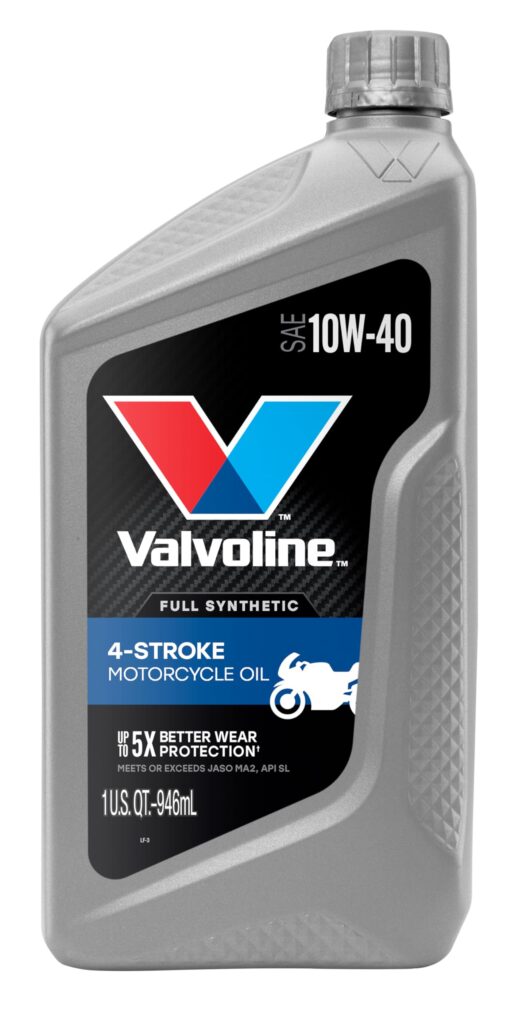
Valvoline’s 4-Stroke Motorcycle Full Synthetic 10W-40 oil is a familiar option for riders who want a synthetic lubricant without stepping too far outside the mainstream. It’s sold in the familiar white quart bottle, and you’ll find it on shelves at auto parts stores and online retailers. This isn’t a boutique oil or a track-only specialist, but rather a general-purpose synthetic designed for a wide range of four-stroke motorcycles, from commuters to weekend cruisers.
In real-world use, this oil does what you’d expect from a full synthetic in the 10W-40 grade. It flows well on cold starts, which is noticeable on chilly mornings when the engine turns over with less resistance compared to conventional oils. Once the engine warms up, the viscosity holds steady, and gear shifts feel reasonably smooth in most bikes. I’ve seen it used in bikes like Honda CB500s, Kawasaki Ninja 650s, and even some older air-cooled twins, and in each case, the engine noise seemed slightly reduced compared to a standard mineral oil. That’s a common benefit of synthetics, and Valvoline delivers it without any surprises.
Key functional features include a JASO MA2 rating, which means it’s safe for wet clutch systems—a must for most street motorcycles. The API SN certification also indicates it meets modern engine protection standards, including some level of wear protection and deposit control. The oil contains a friction modifier package that’s balanced for shared sump engines, where the oil lubricates both the engine and the transmission. In practice, clutch operation remained predictable during my observations, with no slipping or grabby engagement, even after extended rides in stop-and-go traffic.
However, there are trade-offs. This oil is not particularly remarkable in any single area. For riders who push their bikes hard on track days or in extreme heat, a more specialized oil with higher thermal stability or a thicker viscosity might perform better. I’ve noticed that in some high-revving engines, like those in sport bikes, the oil seems to shear down slightly faster than pricier options from brands like Motul or Bel-Ray. After about 1,500 miles of mixed riding, the viscosity felt a bit lighter on the dipstick, though it still maintained adequate protection. It’s not a dealbreaker, but it’s worth noting if you tend to stretch oil change intervals.
Compared to a conventional 10W-40 motorcycle oil, this synthetic offers better cold-start performance and likely better long-term engine cleanliness. The price difference is usually around three to five dollars per quart, so the cost premium is modest. Against a high-end ester-based synthetic, like those from Motul’s 300V line, the Valvoline falls short in high-temperature resistance and film strength, but it also costs significantly less. For most street riders, the Valvoline is a sensible middle ground—better than cheap conventional oil, but not overkill for daily riding.
Who is this oil for? It suits riders who want a reliable synthetic for commuting, touring, or casual weekend trips. It works well in bikes that don’t see extreme track use or constant high-RPM operation. It’s also a good choice for newer riders who want the benefits of synthetic without overcomplicating maintenance. Who should skip it? If you own a high-performance sport bike that you track regularly, or if you ride in very hot climates where oil temps often exceed 240°F, you’ll likely need something with more thermal stability. Similarly, if you have an older air-cooled bike that runs hot, a thicker viscosity or a more robust synthetic might be a better fit.
Ultimately, the Valvoline 4-Stroke Full Synthetic 10W-40 is a competent, no-frills product. It doesn’t excel in any one area, but it doesn’t fail in any critical way either. For the price and availability, it’s a practical option for many riders. Just don’t expect it to transform your bike’s performance—it’s a lubricant, not a magic potion.
"Handpicked and reviewed by the DreamAlliance team — every product is verified and linked directly to Amazon."